

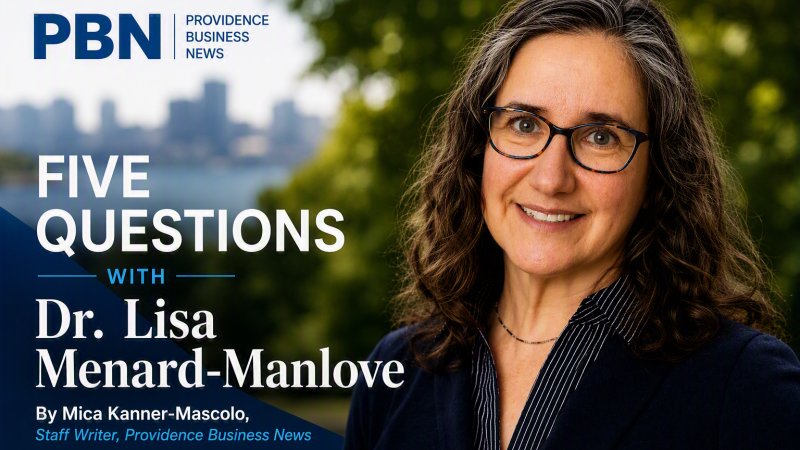
Wood River Health's Chief Medical Officer, Dr. Lisa Menard-Manlove, was recently featured in Providence Business News' "Five Questions" series, sharing insights on healthcare leadership, workforce development and the evolving needs of Rhode Island communities.
In the interview, Dr. Manlove reflects on her career, her passion for mentoring the next generation of healthcare professionals, and her vision for improving access to high-quality care. We are proud to see her expertise and dedication recognized in this spotlight. The article was written by Mica Kanner-Mascolo, Staff Writer for Providence Business News.
Read the article on Providence Business News' website. For the convenience of our patients and community members, we are also sharing Dr. Manlove's responses below.
PBN: You’ve been promoted to chief medical officer after more than 22 years with Wood River Health. What has kept you with the organization for so long?
Menard-Manlove: I wanted to work in a FQHC because I believe in the mission of treating all patients, especially those who may not otherwise have access to quality medical care. At Wood River, when a patient comes in the front door, they may be there for medical, dental, behavioral health, substance use treatment, etc. There is no judgement. As a family physician, I can treat all patients regardless of their socioeconomic situation. I find this both rewarding and challenging, especially in our current healthcare system. I enjoy having patients of all ages, and now have some families where I am taking care of two or three generations, which is very rewarding. Family medicine is never boring – every day it’s something different and I am still learning something new all the time! Living and working in the same community I live in gives me a unique perspective and I think it makes me a better physician. Family physicians take care of the whole person, not just one organ system. That means knowing what other parts of their lives are impacting their health. Knowing the local community gives me a deeper understanding of the events and environments impacting our health.
PBN: What Wood River services were most in demand two decades ago, and what are they today?
Menard-Manlove: Twenty years ago, access to specialists was the most difficult. With the ACA, more patients were able to obtain insurance through the Medicaid expansion program. This is now in jeopardy and has me very concerned that the gains we have made in prevention and treatment of chronic illnesses to prevent complications will backslide. It’s shortsighted. The upstream approach to healthcare – preventing illnesses and complications – is not only much less costly, it leads to better health for our society as a whole, which benefits all of us. Today there are so many complicated factors affecting the health of our population, including financial, housing access to healthy food.
PBN: Wood River is a Federally Qualified Health Center, which in part means it provides care regardless of a patient’s ability to pay. Federally Qualified Health Centers are currently under critical financial strain; how has this affected Wood River’s services and delivery of care?
Menard-Manlove: We are continually looking for ways to continue services to the community. So far we have continued to offer all of our regular services. If funding further decreases both from the federal government and insurance payments, Wood River will be in a situation where we will have to make some difficult decisions.
PBN: Beyond insurance, what social and/or logistical barriers most commonly impact Wood River patients’ ability to equitably access health care?
Menard-Manlove: Primary care in this country is in crisis, and in Rhode Island we are especially affected by the lack of primary care health professionals.
I think it is important to acknowledge that healthcare providers in general are struggling with burnout within our current healthcare system. Supporting our healthcare professionals in their individual journeys is key to Wood River’s long term success. We are working to build up our team to improve access to our local communities. Federal funding is always a challenge. It is important that we continue to advocate for legislation to increase funding for FQHCs as a safety net for the most vulnerable populations, both at the federal and state levels.
PBN: As chief medical officer, how do you plan to balance the needs of patients with the organization’s financial needs to ensure its long-term sustainability?
Menard-Manlove: I’ve had 23 years of experience caring for our patients as of this August so I have a really good pulse on the significant needs of our patient population. Clearly, an organization needs to be financially viable to continue to provide excellent clinical care. Cost-effective care involves lots of moving pieces. We have quality measures that we review throughout the year, which gives us information on numerous recommendations for preventive and chronic care. For example, are our patients receiving appropriate screening for chronic medical conditions? Different departments are collaborating on processes that improve our care delivery.